This site has features that require javascript. Follow these simple instructions to enable JavaScript in your web browser.
If you’re touring the Great Lakes, one of the must-see destinations you won’t want to miss is Lake Superior’s Apostle Islands in Wisconsin.
Once again, Absolute Yachts throws down the gauntlet to the luxury yacht industry with the new Coupé range: sporty, devoted to comfort, and highly versatile.
From light dove to deep carbon, luxury yacht builders are increasingly selecting distinctively gray hull tones to set their vessels apart.
On July 30, 1995, Keith Burhans’ life changed forever. Despite the tragic boating accident in which he lost both legs, he still maintains his status as an avid Great Lakes boater on Lake Ontario.
Building on the wealth of the BENETEAU Trawler DNA, the new Swift Trawler 48 goes above and beyond
For Zena Thomas and her husband Mark, nothing beats spending the day boating on Lake Ontario with their three golden retrievers.
The award winning MJM 4 has been turning heads and making huge waves in the performance yachting world.
As boat exports and imports continue to grow worldwide, boatbuilders face increased demand for CE-certified electrical power systems that provide end-users with increased compatibility when traveling abroad.
Veratron's latest addition to its line of premium marine instruments makes managing more than 40 complex sets of onboard system data simple.
Clear deck plates for visual monitoring of controls or gauges mounted behind panels are popular with boaters and boatbuilders alike.
Boat owners can now benefit from enhanced system display, control and monitoring of their SG gyroscopic units on compatible Garmin multifunction displays.
Albin Group Marine's new line of next-generation DC-driven Circulation Pumps with Brushless Motors combine high flow rates and low power consumption.
Many boat maintenance tasks are put off due to the time and energy needed to complete them. This isn't the case with new Hydrophobic Spray & Rinse from Glidecoat.
While many use their time on the water to take a break from the distractions of everyday life, onboard connectivity is increasingly an important part of owning a boat.
Teak is something that elevates a boat into something special, so it's essential to keep it looking its best.
With marine audio components, adaptability, sound quality and durability are key attributes. The JBL-R3500 WAKE Series stereo source unit from ProSpec Electronics covers these bases and more with a price point that's sure to please boat owners.
To own a boat is to accumulate marine-related tchotchke in the form of gifts.
Many boaters prefer compasses mounted on the centerline of the boat over those on a bulkhead.
Lowrance has launched its next generation of fishing electronics – the new HDS PRO chartplotter/fishfinder, highest resolution ActiveTarget 2 Live Sonar and, ultra high-definition Active Imaging HD.
It doesn't take expensive testing equipment to know it's time to maintain a boat's sanitation lines; one whiff will do it.
Not only do Deluxe All Stainless Steel Trumpet Horns from Schmitt & Ongaro Marine Products produce a serious, attention-grabbing tone, but they also add a luxurious nautical appearance to any boat style.
Restoration is quick and easy with Innovation Award-winning Buff Magic and a Shurhold Clean-N-Simple tip.
Words of exasperation wafting across a marina often signal a boat owner fighting with a jammed zipper or snap that won't catch. This frustrating situation is simple to avoid by using Snap Stick from Shurhold.
Some docks work better on different kinds of waterfronts. What should you consider before shopping, and will a floating or sectional dock work best for you?
A boat lift is an important investment as a boat owner. Protect your boat’s value, safety, and quality with the correct size lift for your watercraft.
The Antique Boat Museum, North America’s premier freshwater boating museum based in Clayton, NY, invites you to join them for the annual 1000 Islands Concours d’Elegance on Saturday!
The NOAA announced in November 2019 that it is in the process of implementing a five-year plan to stop the production of all the traditional paper recreational charts the government has produced for over 200 years.
Merry Christmas from Great Lakes Boating!
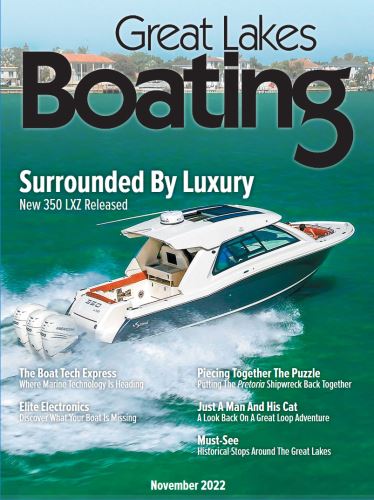
Ragene and Rick Pinson are the proud owners of Poseidon, a unique boating cat on the Great Lakes.
After 20 years in the boating industry I can now add “boat expert” to my resume; at least I can according to one lawyer who recently contacted me.
Many consider a tender a utilitarian means to an end—mere transportation. Argos Nautic's view is that a RIB tender, such as its semi-custom GT14, is an emissary of the yacht it serves.
Already a subscriber? Please check your email for the latest full issue link.